Updated on October 29, 2026
TL;DR
- OUPES has grown from an underdog into a serious contender in portable power, and the new Mega 2 Pro is now its headline 2kWh model (the original Mega 2 is sold out on OUPES’s own store).
- You get 2,048Wh of LiFePO4 capacity, 2,500W of continuous output, a built-in TT-30 RV outlet, app control, and expansion up to 10.24kWh.
- The warranty is now five years, plus a sixth when you register, longer than EcoFlow or Jackery offer on comparable units.
- Independent lab tests back up the capacity claims, but peak surge and max solar numbers are hard to hit in real life.
- Drawbacks: it’s heavy (48.8 lb), the app is basic, support can be uneven, and the Pro takes half the solar input of the original Mega 2.
Table of Contents
- TL;DR
- The Energy Dilemma: Why OUPES Caught My Eye
- What’s New Since Our Last Review
- What Makes OUPES Different?
- The Power Play: Real-World Performance That Matters
- Charging Speed: From “Out of Juice” to “Fully Juiced”
- The Smart Stuff: Tech That Actually Works
- Mega 2 vs. Mega 2 Pro: Which One Is Right for You?
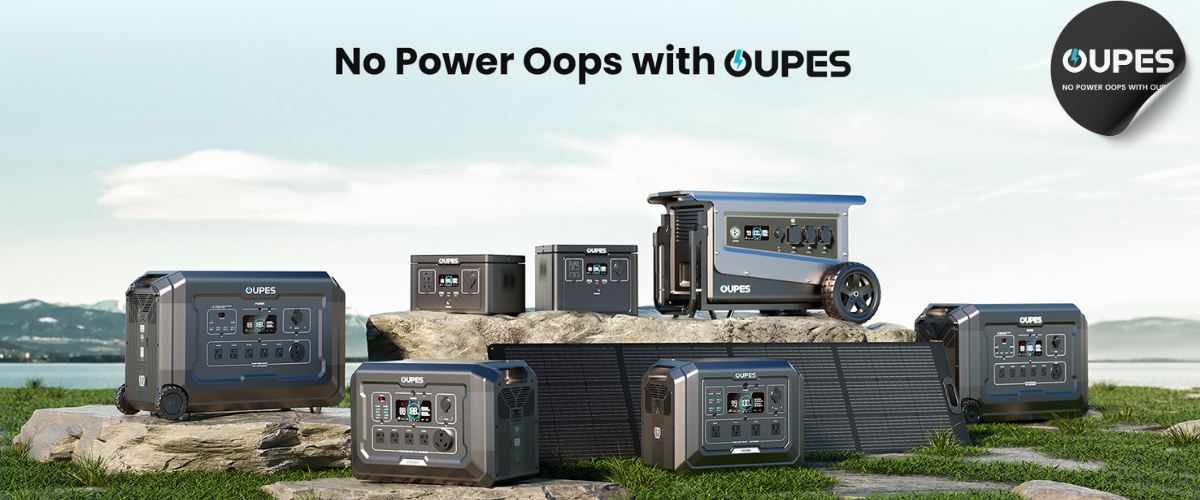
- Meet the Rest of the OUPES Lineup
- What Independent Testers Found
- How OUPES Stacks Up Against EcoFlow and Jackery
- Where OUPES Really Shines
- But Let’s Be Real: It’s Not Perfect
- Who Should Buy an OUPES Power Station?
- The Bottom Line
- Frequently Asked Questions
The Energy Dilemma: Why OUPES Caught My Eye
Picture this: a storm rolls through, the lights flicker twice, and then everything goes quiet. The fridge stops humming. The Wi-Fi drops. Your phone is sitting at 18%. Suddenly you’re doing math on how long the milk will last and whether the neighbors’ generator is going to run all night.
That’s the moment most people start shopping for backup power. And once you start looking, you find two camps: loud, gas-guzzling generators you can’t run indoors, and big-name battery stations that cost a small fortune. OUPES sits in a third camp that’s gotten a lot more interesting over the past year. It’s a younger brand that packs flagship-level specs into its stations, and it has spent 2026 refreshing its lineup, stretching its warranty, and launching a new 2kWh workhorse.
We first covered OUPES when the Mega 2 was its star. A lot has changed since then, so we dug back in to see whether OUPES still earns a spot on your shortlist.
What’s New Since Our Last Review
If you read our original OUPES review, here’s what’s different:
The Mega 2 Pro has taken over. It launched in May 2026 and is now the 2kWh model OUPES leads with. It keeps the Mega 2’s 2,048Wh capacity and 2,500W continuous output, but changes up the charging, ports, and software.
The warranty got a lot longer. OUPES now covers its stations for five years, and you get a sixth year free when you register. That’s a big jump from the two years we mentioned before.
The lineup grew. The new Mega 1 Lite is a lighter, non-expandable take on the Mega 1. The Guardian 6000 V2 brings true 240V power for whole-home circuits. And the compact Exodus 350 and 700 cover smaller camping setups.
The 30% federal tax credit is gone. The Section 25D Residential Clean Energy Credit ended for purchases made after December 31, 2025. You may still see it mentioned on some product pages, but don’t count on it for a 2026 purchase.
What Makes OUPES Different?
OUPES builds its Mega series around three ideas: lots of power, batteries that last, and room to grow.
Every Mega station uses LiFePO4 (lithium iron phosphate) batteries, the same chemistry used in many EVs and home batteries. Compared to older lithium-ion cells, LiFePO4 runs cooler, is more stable, and handles thousands of charge cycles. OUPES rates the Mega 2 Pro at 3,500 to 4,000+ cycles before it drops to 80% capacity, depending on which OUPES page you read. Even at the low end, that’s roughly ten years of charging it every single day.
Then there’s the modular design. Instead of buying a bigger station when your needs change, you add OUPES B2 expansion batteries. The Mega 2 Pro starts at 2,048Wh and scales up to 10.24kWh with four of them. That’s the difference between “keep the fridge cold overnight” and “ride out a multi-day outage.”
Finally, OUPES leans hard on output. The Mega 2 Pro’s 2,500W inverter pushes more continuous power than the EcoFlow and Jackery 2kWh units it competes with, which matters when you want to run a microwave, a space heater on low, or power tools without tripping the unit.

The Power Play: Real-World Performance That Matters
Capacity That Punches Above Its Weight
The Mega 2 Pro packs 2,048Wh of capacity behind a 2,500W pure sine wave inverter, so it’s safe for sensitive electronics like laptops, TVs, and medical devices.
What does that mean in real life? OUPES estimates about 17 hours at a steady 100W load, 3.5 hours at 500W, and 1.7 hours at 1,000W. By our math, a full-size fridge averaging 150W across the day would run about 11 hours on a full charge. Add a router, a few LED lights, and phone charging, and you’ve got a solid overnight setup.
For heavier jobs, the Pro has a Boost Mode that runs devices up to 3,600W for about five minutes, plus a 3,800W surge rating for appliances that need a kick to start. That covers most coffee makers, microwaves, and many power tools.
The port selection is generous:
- Four 120V/20A AC outlets
- One TT-30 RV outlet (the same 30A plug most campers use for shore power)
- A bidirectional Anderson port (12 to 80V, up to 1,000W) for RV DC systems and 12V gear
- Two 140W USB-C ports, enough to fast-charge two laptops at once
- Two USB-A ports and two car sockets
Expandability = Future-Proofing
This is where OUPES really separates itself. With up to four B2 batteries, the Mega 2 Pro grows to 10.24kWh, enough to keep your essentials running for days with some solar help.
Even better, each B2 battery brings its own 2,100W solar input. So as you add batteries, you also add charging capacity, which is a smart design that fixes one of the Pro’s weak spots (more on that below).
If you need even more, the Mega 3 scales to 15.36kWh, and the Guardian 6000 V2 goes all the way to 41.4kWh.
Charging Speed: From “Out of Juice” to “Fully Juiced”
Need power by dinner? The Mega 2 Pro gives you several ways to fill up:
- Wall outlet: up to 1,800W, about 1.5 hours to full according to OUPES
- Solar: up to 1,000W
- Wall plus solar together: up to 2,800W
- Car alternator: OUPES’s 800W alternator charger fills it in about 2.75 hours while you drive
- Expansion batteries: each B2 adds another 2,100W of solar input
Pass-through charging means you can keep using it while it charges, so your devices stay powered while the battery refills.
One reality check: OUPES’s fastest charge times assume ideal conditions. When The Solar Lab tested the original Mega 2, a full wall charge took 2 hours and 7 minutes, and real-world solar depends heavily on your panels, the weather, and the time of year. Plan around what your panels can actually deliver, not the maximum input.
The Smart Stuff: Tech That Actually Works
The OUPES app connects over Wi-Fi or Bluetooth, so you can check battery level, see exactly how many watts are going in and out, and switch ports on or off from your phone. That’s handy when the station is tucked in a garage or closet.
The Mega 2 Pro adds over-the-air firmware updates, something the original Mega 2 didn’t support. That means OUPES can fix bugs and improve performance without you shipping the unit anywhere.
It also works as a 2,500W UPS. If the grid drops, the Pro switches over in 20 milliseconds or less, fast enough to keep a fridge, router, or CPAP running without a hiccup. If you work from home, that’s the difference between a dropped Zoom call and not even noticing the outage.
The smart features aren’t perfect. Testers have called the OUPES app dated next to bigger brands, and some owners report connection drops. But for the basics, it does the job.
Mega 2 vs. Mega 2 Pro: Which One Is Right for You?
Both have the same 2,048Wh battery and 2,500W continuous output. The differences come down to charging and ports:
| Mega 2 | Mega 2 Pro | |
|---|---|---|
| Availability on OUPES.com | Sold out | In stock |
| Capacity | 2,048Wh | 2,048Wh |
| Continuous output | 2,500W | 2,500W |
| High-load rating | 5,400W surge | 3,600W Boost, 3,800W surge |
| Wall charging | 1,600W | 1,800W |
| Max solar input | 2,100W | 1,000W |
| Max wall + solar | 3,700W | 2,800W |
| USB-C | 2 x 100W | 2 x 140W |
| Anderson DC port | 12V/30A output | 12 to 80V, up to 1,000W, bidirectional |
| Over-the-air updates | No | Yes |
| Weight | 48.5 lb | 48.8 lb |
Choose the Mega 2 Pro if you want faster wall charging, stronger DC power for RV gear, faster USB-C, and a unit that keeps getting software updates.
Choose the original Mega 2 if you can still find one in stock and you plan to run a big solar array, since it takes twice the solar input. OUPES itself notes that the Mega 2’s surge rating and the Pro’s Boost Mode measure different things, so don’t compare those numbers head to head.
Meet the Rest of the OUPES Lineup
The Mega 2 Pro is the sweet spot for most people, but OUPES has options on both sides of it:
| Model | Best for | Capacity | Output | Max solar | Weight | Expands to |
|---|---|---|---|---|---|---|
| Mega 1 Lite | Camping, CPAP, short outages | 1,024Wh | 2,000W | 800W | 26.8 lb | Not expandable |
| Mega 1 | Same, with room to grow | 1,024Wh | 2,000W | 800W | 27.8 lb | 5,120Wh |
| Mega 2 Pro | Most homes and RVs | 2,048Wh | 2,500W | 1,000W | 48.8 lb | 10.24kWh |
| Mega 3 | Longer outages, bigger loads | 3,072Wh | 3,600W | 2,100W | 83.3 lb | 15.36kWh |
| Guardian 6000 V2 | 240V appliances, home circuits | 4,608Wh | 6,000W (240V) / 3,600W (120V) | 3,600W | 111 lb (original model) | 41.4kWh |
Mega 1 Lite: A grab-and-go option at under 27 pounds that still puts out 2,000W. It recharges from the wall in about 46 minutes and has two 140W USB-C ports. The catch is that it can’t take expansion batteries.
Mega 1: The same capacity and output as the Lite, but it can expand to 5,120Wh. Bob Vila scored it 4.7 out of 5 and called it a lesser-known brand that can compete with the big names.
Mega 3: The step up for longer outages, with 3,600W of output and 2,100W of solar input. At 83.3 pounds, it’s more of a “set it and leave it” station.
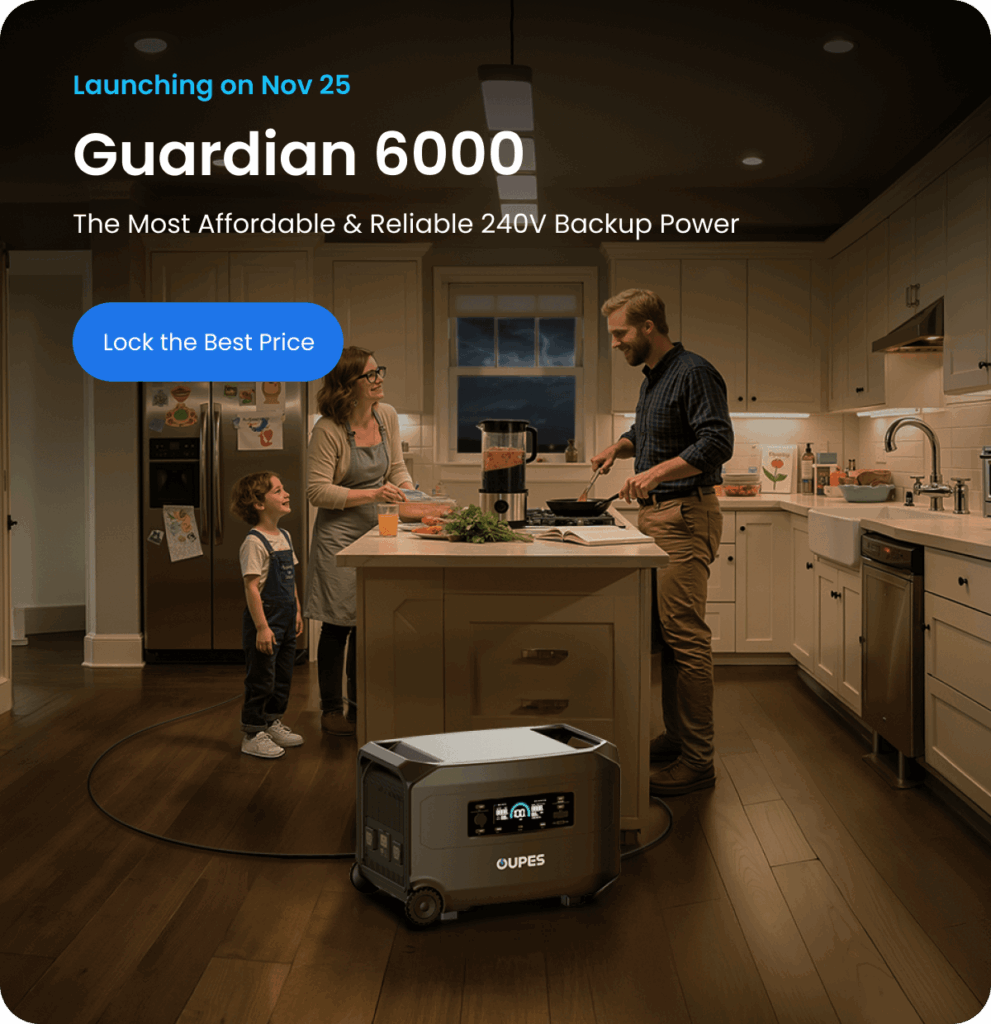
Guardian 6000 V2: OUPES’s home backup flagship and its first line with native 240V output, so it can run things the Mega series can’t, like well pumps, dryers, and central AC. It has big wheels and a suitcase-style handle, but it’s well over 100 pounds.
Exodus 350 and 700: Compact stations for tents, phones, laptops, and lights.
What Independent Testers Found
We haven’t bench-tested OUPES units ourselves, so we looked at what independent testers found. There’s no full lab test of the Mega 2 Pro yet, but the original Mega 2 shares its capacity and continuous output rating, so it’s the best preview we have.
The Solar Lab (Mega 2): Ran a 2,330W load for 44 minutes, which works out to 83% efficiency, right in line with most power stations. A full wall charge took 2 hours and 7 minutes. It found the 2,100W solar rating hard to use in practice, since matching it takes far more panels than most people own. It also found a 3,000W load shut the unit down instantly, despite the 5,400W surge rating, and noted some idle battery drain.
TechRadar (Mega 2): Reported 86% inverter efficiency and praised the value, Wi-Fi and Bluetooth control, and expandability. Its only listed con was the lack of a built-in light.
Bob Vila (Mega 1): Scored it 4.7 out of 5.
The Solar Lab (brand overall): Across seven OUPES models, it rated the brand 3.3 out of 5, with high marks for value and middling scores for performance and customer service. It praised OUPES’s support on the Mega 3 but called the Mega 1’s app dated.
The takeaway: OUPES delivers the capacity it promises. Just size your setup around the continuous rating, not the peak numbers.
How OUPES Stacks Up Against EcoFlow and Jackery
| OUPES Mega 2 Pro | EcoFlow DELTA 3 Max | Jackery Explorer 2000 v2 | |
|---|---|---|---|
| Capacity | 2,048Wh | 2,048Wh | 2,042Wh |
| Continuous output | 2,500W | 2,400W | 2,200W |
| Max solar input | 1,000W | 500W | 400W |
| TT-30 RV outlet | Yes | No | No |
| UPS switchover | 20ms | Under 10ms | 20ms |
| Weight | 48.8 lb | 44.8 lb | 39.5 lb |
| Warranty | 5 years + 1 with registration | 3 years + 2 with registration | 3 years + 2 with registration |
On paper, OUPES wins on output, solar input, RV-friendliness, and warranty. EcoFlow switches over faster, which matters if you’re protecting a computer or NAS. Jackery is the lightest of the three by almost ten pounds and has a published UL 2743 safety listing.
Where OUPES Really Shines
- Muscle where it counts: 2,500W of continuous output, more than the EcoFlow and Jackery 2kWh units it goes up against.
- Built for RVs: A TT-30 outlet and a 1,000W Anderson port mean less adapter juggling for campers and van life.
- Room to grow: Start at 2kWh and scale to 10.24kWh with B2 batteries, each adding its own solar input.
- A warranty that means business: Five years, six with registration.
- Long-life batteries: LiFePO4 cells rated for 3,500+ cycles to 80% capacity.
- Seamless backup: A 2,500W UPS that keeps essentials running when the grid drops.
- Versatility: Home backup, camping, RV trips, job sites, and tailgates, all from one box.
But Let’s Be Real: It’s Not Perfect
Solar Charging Isn’t Always Ideal
The Mega 2 Pro takes 1,000W of solar, half of what the original Mega 2 accepted. That’s still more than the EcoFlow DELTA 3 Max or Jackery Explorer 2000 v2, but if you’re dreaming of a huge rooftop-style array, you’ll need B2 batteries (each adds 2,100W of solar input) or a Mega 3. And as testers found with the Mega 2, real-world solar input is almost always lower than the max on the spec sheet.
Peak Numbers Run Optimistic
The Solar Lab saw the original Mega 2 shut down at a 3,000W load despite its 5,400W surge rating. The Pro uses a different Boost Mode and a 3,800W surge rating, so plan around the 2,500W continuous figure and you won’t be disappointed.
Portability Has Limits
At 48.8 pounds, the Mega 2 Pro is portable in the “two hands, short distance” sense. It’s fine for moving from the garage to the living room or loading into an RV, but it’s not something you’ll carry to a campsite. If weight is your top priority, the Mega 1 Lite or the Jackery Explorer 2000 v2 are easier to haul.
Brand Recognition Still Growing
OUPES doesn’t have the long track record or massive accessory ecosystem of EcoFlow or Jackery. Owner reviews are mostly positive about shipping, packaging, and performance, but some report slow warranty claims, app connection issues, units that wouldn’t power back on, and loud fans. OUPES had responded to 43% of its negative Trustpilot reviews when we checked. We also couldn’t find a published UL 2743 safety listing for the Mega 2 Pro, so if your insurer, landlord, or HOA requires one, confirm it before you buy.
Mega Models Are 120V Only
None of the Mega stations put out 240V on their own. If you need to run a well pump, dryer, or central AC, you’ll want the Guardian 6000 V2.
Who Should Buy an OUPES Power Station?
OUPES is a great fit for:
- Homeowners who want quiet, fume-free backup for the fridge, Wi-Fi, lights, and medical devices during outages.
- Remote workers who can’t afford to drop offline when the power flickers.
- RV owners and van lifers who want a TT-30 outlet and strong 12V power without a pile of adapters.
- Campers and overlanders who want serious power (the Mega 1 Lite is the lightweight pick).
- Planners who want to start small and add batteries over time.
- Tech enthusiasts who like monitoring every watt from an app.
It’s less ideal if you need something ultra-light, need 240V from a compact unit, or want the most polished app and the longest brand track record.
The Bottom Line
OUPES has grown up. The Mega 2 Pro delivers more output, more solar input, a built-in RV outlet, and a longer warranty than comparable EcoFlow and Jackery units, and it can grow with you all the way to 10.24kWh. You give up some weight, software polish, and brand history to get it.
If that trade works for you, the Mega 2 Pro is one of the smartest power stations you can buy right now. Register it the day it arrives to lock in that sixth warranty year, plan around its continuous rating instead of its peak numbers, and you’ll have a station that’s ready for the next blackout, road trip, or weekend off-grid.
So what’s your plan: one big station that covers it all, or a smaller setup you can build on over time?
Frequently Asked Questions
What is a portable power station, anyway? It’s a big rechargeable battery with built-in outlets. Think of it as a quiet, fume-free generator you can use indoors, charged from the wall, solar panels, or your car.
Is OUPES a good brand? Yes, especially for value. Independent testers rate it highly for what you get and call its performance solid, though peak surge and solar numbers run optimistic. Customer support gets mixed reviews.
Is OUPES a Chinese company? Yes. The US OUPES trademark is held by Shenzhen Jiexun Energy Storage Co., Ltd. in Shenzhen, China. OUPES ships US orders from warehouses in California and Georgia.
What’s the difference between the Mega 2 and the Mega 2 Pro? Same 2,048Wh battery and 2,500W output. The Pro charges faster from the wall, has faster USB-C, a stronger Anderson DC port, and over-the-air updates. The original Mega 2 takes twice the solar input.
How long does the Mega 2 Pro last? The battery is rated for 3,500 to 4,000+ cycles before dropping to 80% capacity. That’s roughly ten years or more of daily use.
Can it power my home appliances during an outage? Yes, within its 2,500W limit. It can run a fridge, microwave, coffee maker, router, TV, lights, and many power tools. A full-size fridge averaging 150W would run about 11 hours on a full charge.
How long does it take to charge? About 1.5 hours from a wall outlet, according to OUPES. Solar charging depends on your panels and the weather. You can also charge from a car with OUPES’s 800W alternator charger in about 2.75 hours.
Can I expand the battery capacity later? Yes. The Mega 2 Pro takes up to four B2 batteries for 10.24kWh total. The Mega 1 takes two (5,120Wh), the Mega 3 takes six (15.36kWh), and the Mega 1 Lite isn’t expandable.
Is it safe to use indoors? Yes. There are no fumes, and LiFePO4 is one of the most stable battery chemistries available.
Is it waterproof or outdoor-ready? No. The Mega 2 Pro is rated IP21, which only protects against dripping water. Keep it covered and out of the rain.
Can it run 240V appliances? Not the Mega models. For 240V well pumps, dryers, or central AC, look at the Guardian 6000 V2.
How heavy is it? The Mega 2 Pro weighs 48.8 pounds. The Mega 1 Lite is the lightest Mega at 26.8 pounds.
What’s the warranty? Five years, plus a free sixth year when you register your unit with OUPES.
Can I still get the 30% tax credit? Not for a 2026 purchase. The federal Residential Clean Energy Credit ended for purchases made after December 31, 2025. Check with your state or utility for local incentives.