Updated on March 22, 2026
TLDR
The Lymow One is a wire-free robotic lawn mower built for large, complex yards – and it delivers where most of the category has historically failed.
- What it is: A tank-tracked, dual-blade autonomous mower with RTK-VSLAM navigation and no boundary wire requirement
- Who it’s for: Homeowners with half an acre or more, steep slopes, thick grass varieties, or multi-zone layouts
- Top strengths: Full-size rotary mulching blades, impressive all-terrain capability, no subscription fees, meaningful daily coverage
- Biggest limitation: Louder than razor-disc competitors; lawn edges and tight borders may still need manual string-trimmer follow-up
- Quick verdict: The most capable robot mower under $3K for genuinely difficult yards – but overkill and over-budget for flat, simple suburban lots
Jump to:
- TLDR
- Introduction
- What Is the Lymow One?
- Key Features and What Owners Are Actually Experiencing
- Pricing, Value, and the ROI Conversation
- Who Should Buy the Lymow One
- Bottom Line
- FAQ
- What kind of yards is the Lymow One actually designed for?
- Does the Lymow One require a subscription or monthly fee?
- How does the Lymow One handle navigation under trees?
- What grass types work best with the Lymow One?
- Is the Lymow One loud compared to other robot mowers?
- How difficult is setup?
- How does the Lymow One compare to the Mammotion Luba?
- What are the risks of buying from a Kickstarter-origin brand?
- Does the Lymow One handle lawn edges and tight borders?
- What warranty does the Lymow One come with?
Introduction
Most robot mowers are designed for easy mode – flat, compact, obstacle-free lawns where a disc of razor blades and some boundary wire gets the job done. If you’ve watched a competing mower get confused by a tree root, stall out under dense canopy, or flatly refuse a slope steeper than a gentle incline, you already know the problem. The real question for anyone shopping the category isn’t whether a robot mower can cut grass. It’s whether one can handle the kind of yard most people actually live with.
That’s the problem Lymow set out to solve. The Lymow One became the most-funded robotic mower in Kickstarter history – over $7.4 million pledged by more than 3,400 backers – on the promise of full-size rotary blades, tank-style tracks, wire-free navigation, and daily coverage numbers that compete with traditional mowing. Units are now shipping and in real yards. Real owners are reporting back. Here’s what the actual evidence looks like.
What Is the Lymow One?
The Core Machine
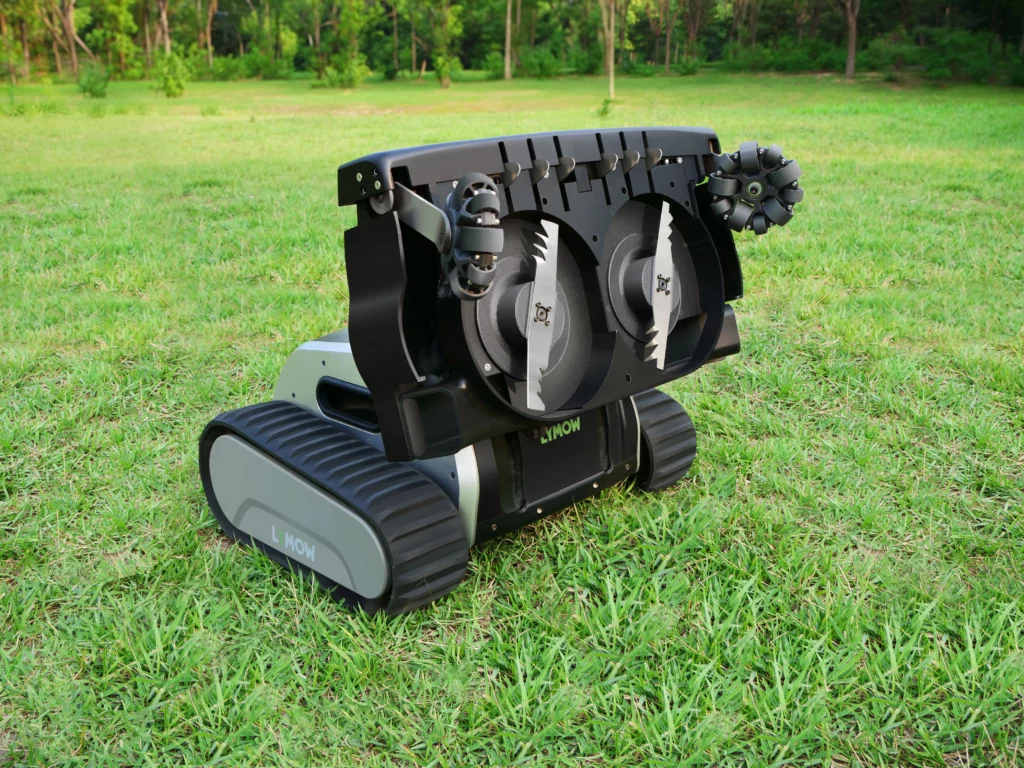
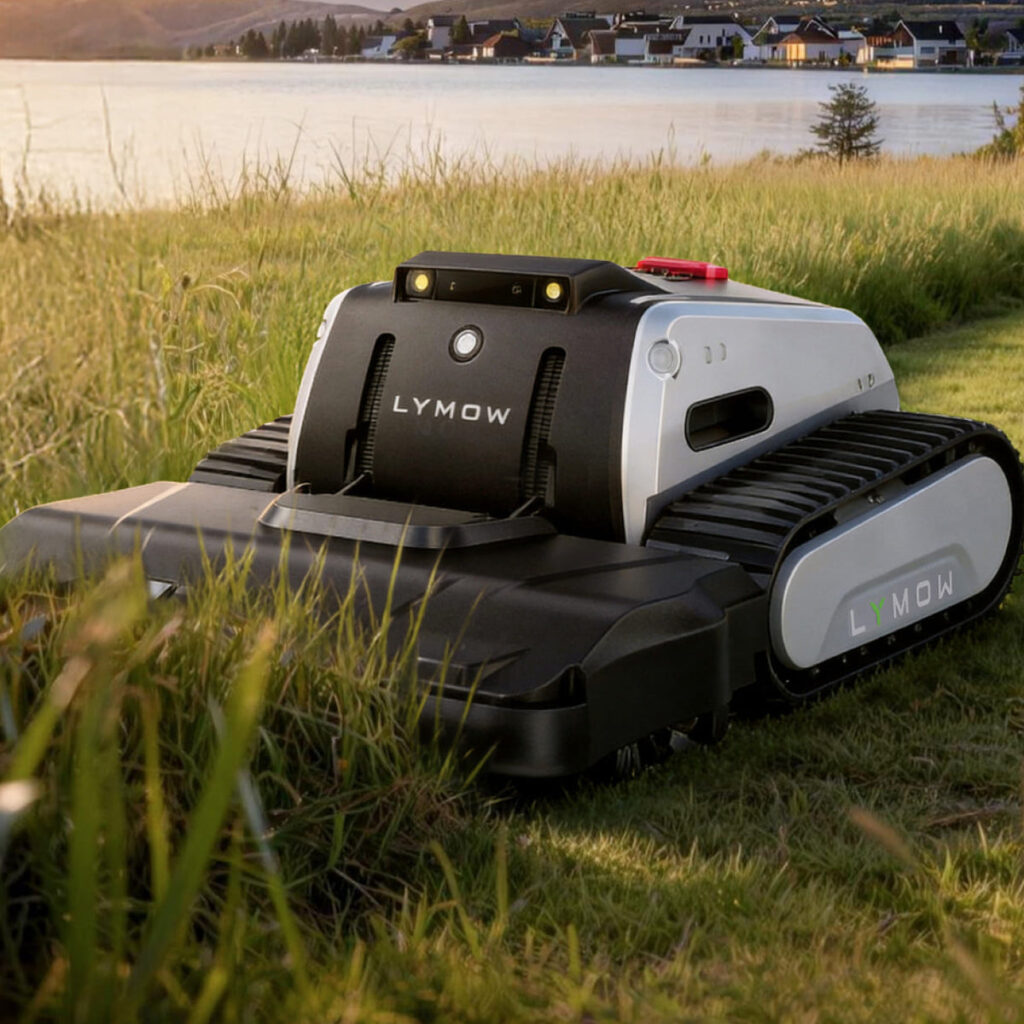
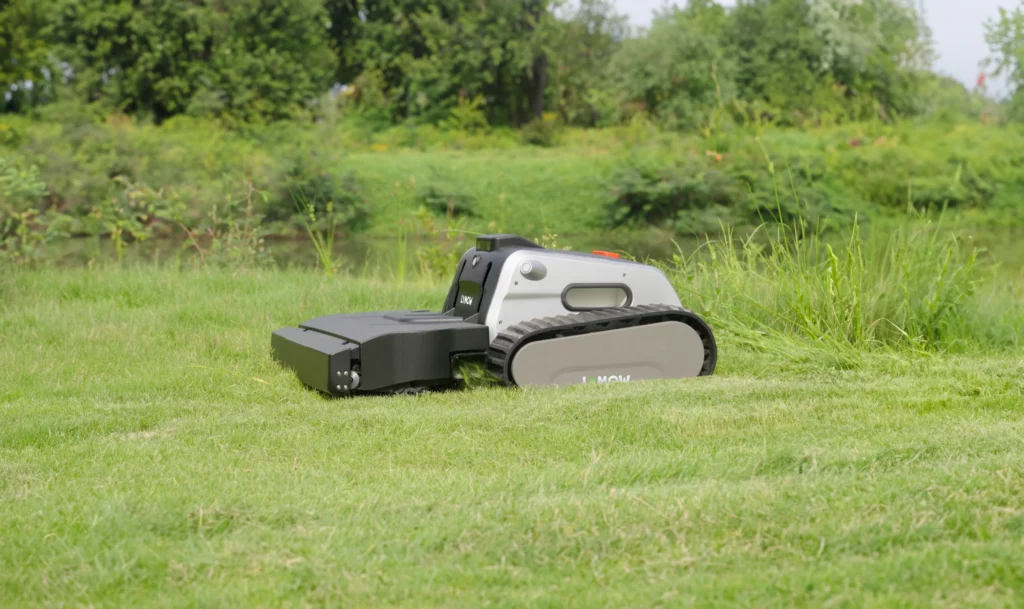
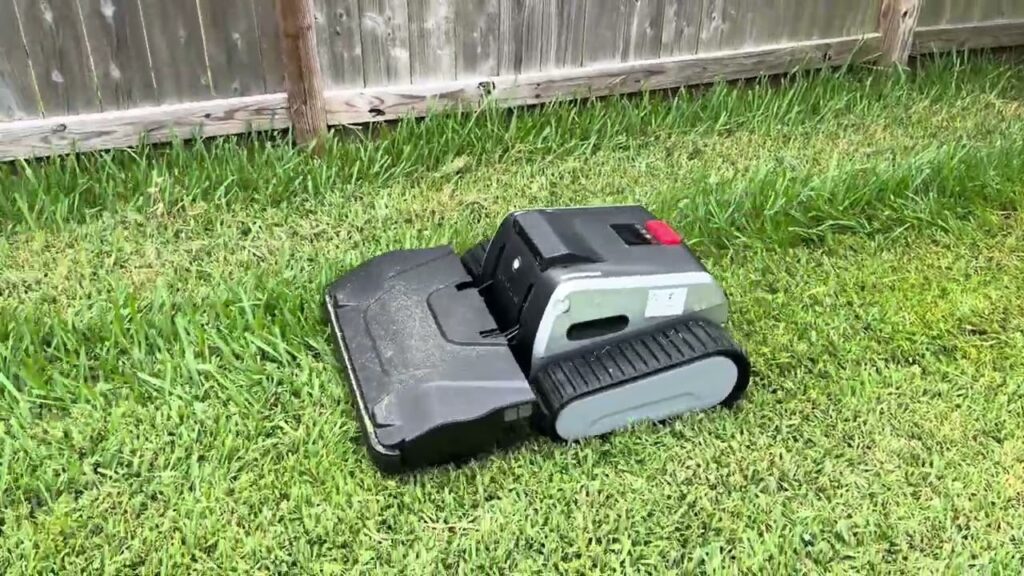
The Lymow One is a fully autonomous robotic lawn mower designed to handle large, complex properties without any buried perimeter wire. It runs on continuous tank-style tracks, uses a dual rotary mulching blade system spinning at up to 6,000 RPM, and navigates using a combination of RTK satellite positioning and VSLAM – visual simultaneous localization and mapping. The battery is a 528Wh LiFePO4 pack rated for 2,000 charge cycles, and the frame is a one-piece die-cast aluminum alloy body engineered for durability across rough terrain.
The company behind it, founded and led by Wangshu Gao, brings credible pedigree to the category. Gao spent eight years heading R&D at SharkNinja before founding Lymow – which means he knows what it takes to engineer a consumer product that actually survives real household conditions rather than just performing well in controlled demos. That context matters when evaluating whether the hardware will hold up long-term.
The Two Current Models
Lymow currently sells the original Lymow One and the newer Lymow One Plus. The Plus is the upgraded second-generation version, launched at CES 2026, featuring reinforced SK5 tool-steel blades, a redesigned cyclone airflow cutting system, a more powerful peak motor at 1,785W, and an upgraded AI processor capable of 10 TOPS – up from 6 TOPS in the original. The One Plus can recognize over 25 yard objects including flowerbeds, bicycles, sprinklers, hedgehogs, and people.
The original Lymow One is currently priced at $2,499, with discounts running periodically. The One Plus is available for pre-order at $2,999 with a March 2026 availability target. Neither model requires a subscription – no monthly fee, no coverage area locked behind a paywall, no internet connection required to run the core mowing functions. You can operate entirely offline once setup is complete, though you’ll miss OTA software updates without a connection.
Key Features and What Owners Are Actually Experiencing
The Blades – The Differentiator That Actually Matters
The most significant thing about the Lymow One isn’t the tracks or the navigation. It’s the blades. The overwhelming majority of robot mowers on the market – Husqvarna, Worx, Segway, Mammotion – use small pivoting razor-disc blades. These work fine on fine, thin grass varieties. They do not work well on thick, dense southern grasses like St. Augustine, Zoysia, or Bermuda. What owners of those grass types report is that razor-disc mowers essentially plane the tops of blades rather than cut them cleanly, leaving ragged, stressed grass with a rough finish rather than a crisp cut.
The Lymow One’s dual rotary mulching blades are a fundamentally different mechanism. They spin at between 3,000 and 6,000 RPM and operate more like a conventional walk-behind mower than a robotic grooming tool. A high-speed centrifugal fan distributes the finely shredded clippings back across the lawn, preventing buildup and returning nutrients to the soil. Owners with St. Augustine specifically are emphatic about this. One detailed real-world review from a homeowner with 32 oak trees and a thick St. Augustine lawn noted the cut quality rivaled what they achieved manually, with the mower getting into dips and uneven patches their lawn service routinely missed. That’s not a minor improvement – for the right grass type, it’s the entire case for buying this machine instead of something cheaper.
Navigation Under Real Conditions
The RTK-VSLAM system combines Real-Time Kinematic satellite positioning with visual and sensor-based localization. The RTK base station is a physical antenna you mount permanently on your property – it communicates with the mower via LoRa radio at no ongoing cost, requires no third-party subscription, and covers a range of 300-500 meters in typical conditions and up to 1 kilometer in open environments.
The practical benefit of the VSLAM fallback is real and well-documented by owners. Under dense tree cover, where GPS signals drop or become unreliable, the system switches seamlessly to visual data, wheel encoders, and IMU readings to maintain positioning. One New Zealand owner with a 2,000m² property on rough, rocky ground with challenging native grass described setup as “pretty straightforward,” with the trickiest step being finding a suitable outdoor power outlet location for the RTK antenna. Once running, the mower handled uneven conditions, drainage dips, and inclines without getting stuck or losing position. This kind of GPS-under-canopy performance is a consistent point of praise across tech forums and early adopter communities – it’s a real differentiator against GPS-only competitors that struggle in partially shaded yards.
The Tracks – Terrain Claims That Check Out
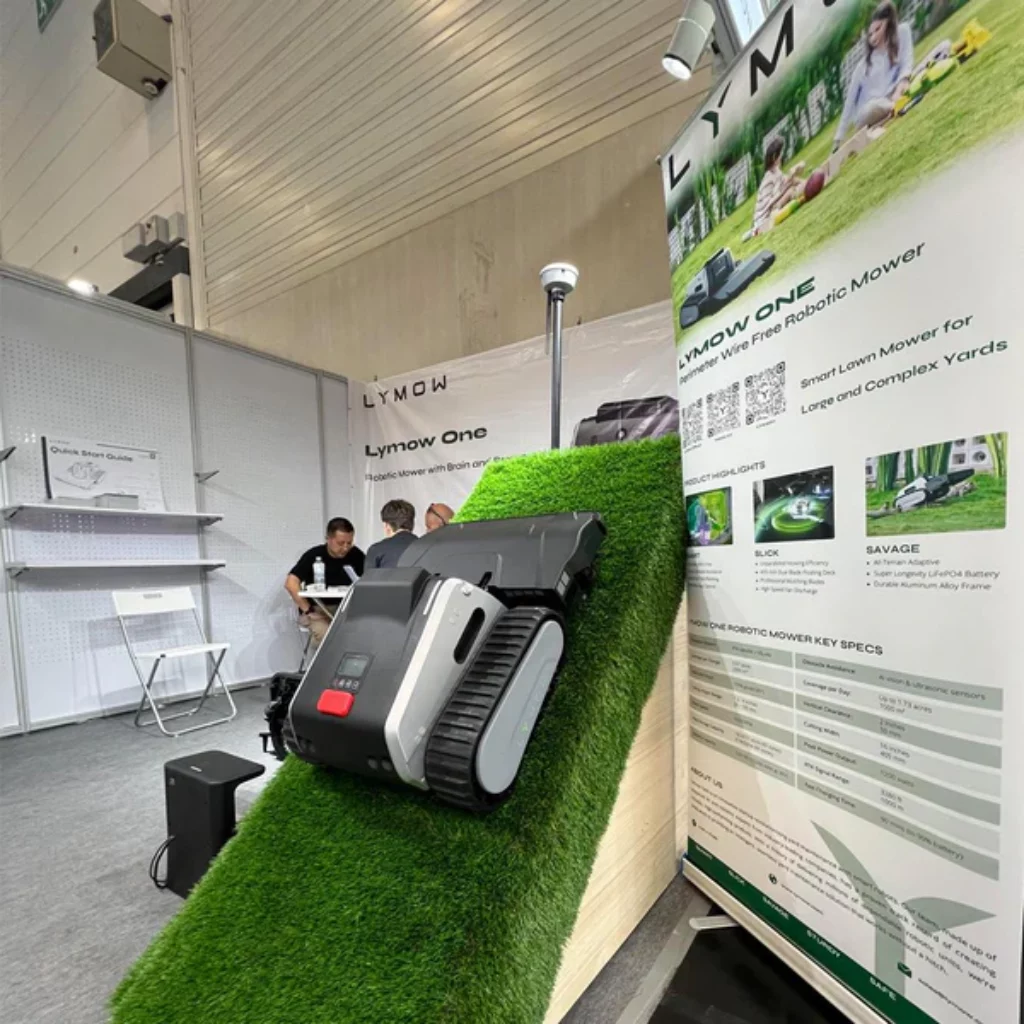
The machine weighs around 78 lbs and rides on continuous tank-style tracks. The advertised slope capability is 45 degrees – a 100% gradient – which exceeds what most wheeled competitors handle. More importantly, early owner reports and independent testing confirm the spec translates to reality. On rocky, uneven terrain with drainage ditches, soft soil, and wet grass, the tracks provide stable traction where wheeled mowers would spin, slip, or tear up turf.
One forum comparison between the Lymow One and the Segway Navimow at similar price points noted that the Segway’s wheeled system handles about 1,500m² at slopes up to 27 degrees, while the Lymow covers 7,000m² per day at 45-degree slopes – with conventional mowing blades instead of razor discs. Independent reviewers have also noted the machine handles fallen fruit, pinecones, and small debris by shredding them rather than getting stuck, which is a practical benefit on properties with mature trees.
The trade-off is noise. Owners and reviewers consistently note that the Lymow One is louder than typical razor-disc robot mowers. This is expected – spinning dual rotary blades at 6,000 RPM is physically noisier than the whisper-soft razor discs on conventional models. For noise-sensitive neighborhoods, this matters. The practical workaround most owners use is scheduling nighttime mowing, which the RTK-VSLAM system supports without any degradation in navigation performance. The front LED lights illuminate the cutting path in the dark.
App Control and Zone Management
The Lymow app handles initial setup, zone configuration, cutting height adjustment, schedule management, and no-go zone mapping. Setup takes 30-60 minutes following the app’s guided walkthrough – you walk the mower around the property perimeter to establish the map, set any exclusion zones, and configure preferences per zone. The Lymow One Plus supports up to 80 independent zones, each with its own schedule and cutting height. Once active, the mower returns to the charging dock when the battery drops, then resumes exactly where it left off without any user input.
The app experience draws mixed but generally positive feedback. Setup is reported as manageable for tech-comfortable users, and the zone customization is genuinely useful for properties with distinct areas – front yard, back yard, garden borders, utility zones. Some early Kickstarter backers flagged app-level issues including occasional no-go zone mapping glitches and charging contact oxidation on the dock. These are first-generation hardware and software issues that are typical of Kickstarter-born products, and Lymow has issued OTA updates that have addressed several of the early software bugs. The charging port oxidation issue is a legitimate hardware concern worth monitoring on older units.
Pricing, Value, and the ROI Conversation
What You’re Actually Paying
The Lymow One is currently $2,499 with a 2-year warranty included. Kickstarter backers who hit the stretch goal received a 3-year warranty. The Lymow One Plus launches at $2,999 with pre-order discounts available. Neither model carries any recurring fees.
For context, Husqvarna Automower units covering comparable area typically require professional boundary wire installation, adding several hundred dollars on top of the unit cost. Wire-free RTK competitors like the Mammotion Luba range are priced similarly, but use razor-disc cutting systems that perform differently on thick grass types. The Segway Navimow X430 has excellent navigation software by most accounts, but covers less terrain at lower slope tolerances for comparable money.
The ROI case is concrete for owners paying for professional lawn service. One owner testimonial circulating across Lymow’s community noted they were spending around $200 per month on lawn maintenance and calculated the mower would pay for itself within a year. For half-acre-plus properties in markets where lawn service runs $150-$300 monthly, that math holds up.
Costs to Account For
Blades are consumables and need periodic replacement – Lymow sells replacement sets and has run promotions bundling spare blade sets with purchase. The RTK antenna needs a permanent outdoor mounting location with power access. Shipping outside the US runs up to $300 for international orders, which matters for buyers in regions where Lymow doesn’t yet have distribution infrastructure. Return shipping on a 78-lb machine, should you need it, is not trivial.
The more significant long-term consideration raised by critical reviewers is parts and support availability. Lymow is a direct-to-consumer brand with no physical dealer network. If a motor fails, there’s no local service center – you’re working through email support or self-servicing. Support response times have drawn complaints, including at least one forum report from a buyer who couldn’t reach Lymow support after multiple days of attempts. This is the structural risk of buying first-generation hardware from a startup that has no physical service footprint. It’s a real consideration, not a deal-breaker, but worth factoring into the purchase decision.
Who Should Buy the Lymow One
The Right Fit
This machine is built for a specific type of homeowner. If your property is half an acre or larger, has meaningful terrain complexity – slopes, multiple distinct zones, thick southern grass varieties, dense tree cover, or some combination – the Lymow One is likely the most capable autonomous mower at this price point. Tech-comfortable homeowners who don’t mind a 30-60 minute setup process, and who want genuine set-it-and-forget-it daily coverage without a subscription or buried wire infrastructure, are the sweet spot.
Owners of St. Augustine, Zoysia, Bermuda, and other thick or dense grass types should pay particular attention. The rotary blade system handles these grasses categorically better than razor-disc systems. This isn’t a marginal difference – multiple independent owners with these grass types describe the Lymow One as the first robot mower that actually worked for them.
Homeowners who have previously given up on robot mowers because their yards were “too difficult” – too steep, too rough, too complex – are the exact customer this machine was built for. The terrain performance evidence holds up to scrutiny.
Who Should Look Elsewhere
If your yard is flat, under a quarter acre, and covered in fine fescue or another thin-blade grass variety, there are simpler and significantly cheaper robot mowers that will serve you better without the added complexity, weight, and noise of the Lymow system. You don’t need a tank to mow a postage stamp.
Buyers who prioritize near-silent operation should be prepared for the Lymow’s noise level – it is meaningfully louder than whisper-quiet competitors. Nighttime scheduling mitigates this, but if sound is a primary concern, the trade-off is real.
Anyone expecting complete edge-to-fence perfection without any manual follow-up should also temper expectations. Like most robot mowers, the Lymow One handles field mowing superbly but may leave a strip along tight borders and fences that requires occasional string-trimmer attention. One owner with extensive garden borders found the workaround was installing a mowing strip around garden beds, reducing manual edge work to a quick periodic pass rather than a full chore – a reasonable accommodation for most yards, but worth knowing going in.
Finally, buyers who want Husqvarna- or Segway-level dealer support and parts availability should weigh the startup risk. Lymow has delivered on its Kickstarter commitments and is iterating the product line, which are positive signals. But it is a young company without a physical service network, and that is a legitimate risk on a $2,500 purchase.
Bottom Line
The Lymow One does something most robot mowers have avoided: it takes large, complex, real-world lawns seriously. The combination of full-size rotary mulching blades, tank-style tracks, wire-free RTK-VSLAM navigation, and meaningful daily coverage makes it the most credible autonomous mower for challenging properties currently available under $3K. The no-subscription model, aluminum frame construction, 2,000-cycle LiFePO4 battery, and the company’s active product iteration – from the original One to the One Plus – all point toward a company building for longevity rather than a quick crowdfunding exit.
The risks are real and worth naming clearly: startup-level after-sales support, no physical dealer network, first-generation hardware quirks on early units, and a price point that only makes sense if your yard genuinely justifies it. For the homeowner with a sloped, heavily treed, thick-grass property who has burned through cheaper alternatives, the Lymow One is the machine the robot mower category has needed for years. For everyone else, there are better-fitted options at lower prices.
What’s your biggest hesitation about putting a $2,500 robot loose in your yard – the technology, the company, or something else?
FAQ
What kind of yards is the Lymow One actually designed for?
The Lymow One is built for large, complex properties – half an acre or more, with sloped terrain, thick grass varieties, multiple zones, obstacles, or heavy tree cover. It is overkill for small, flat, straightforward yards and is priced accordingly. If your lawn is challenging enough that other robot mowers have failed you, this is the machine worth evaluating.
Does the Lymow One require a subscription or monthly fee?
No. There are no subscription fees, no coverage area licenses, and no mandatory internet connection for core mowing functions. The RTK base station communicates via LoRa radio using your own property as the signal source, and the system operates fully offline once setup is complete. You’ll only need internet connectivity to receive OTA software updates or use remote app control.
How does the Lymow One handle navigation under trees?
When RTK satellite signals are blocked by dense tree canopy, rooflines, or weather, the system automatically switches to visual SLAM data, wheel encoders, and inertial measurement unit readings to maintain positioning. Multiple owners with heavily treed properties confirm this fallback works reliably in practice – the mower doesn’t get disoriented or stall under canopy the way GPS-only competitors often do.
What grass types work best with the Lymow One?
The dual rotary blade system performs best on thick, dense grass varieties – St. Augustine, Zoysia, Bermuda, and Tall Fescue are the types where the Lymow One most clearly outperforms razor-disc competitors. The high-RPM rotary blades cut these grasses cleanly rather than planing them, which matters for lawn health and cut finish. It handles fine grasses too, but those don’t require the Lymow’s level of blade power to cut properly.
Is the Lymow One loud compared to other robot mowers?
Yes, measurably so. The dual rotary blades spinning at 6,000 RPM are physically louder than the razor-disc systems used in most competing robot mowers. This is a trade-off inherent to the cutting system design. Most owners who find this an issue schedule the mower for nighttime operation, which the navigation system handles without any performance loss.
How difficult is setup?
Setup takes approximately 30-60 minutes. You mount the RTK antenna in a suitable outdoor location with power access, then use the app to walk the mower around your property perimeter to establish the map. No wire-burying is required. You can create multiple zones with individual settings and schedules. The experience is generally described as manageable for anyone comfortable with smartphone apps, with the antenna placement being the most physically involved step.
How does the Lymow One compare to the Mammotion Luba?
Both use wire-free RTK navigation and target large, complex yards. The primary differentiator is the cutting system – the Lymow One uses rotary mulching blades that handle thick grass varieties significantly better than the razor-disc approach used by Mammotion. The Luba has a strong software and navigation reputation and may suit buyers with fine grass types or those prioritizing quieter operation. For thick southern grasses and extreme slopes, the Lymow’s hardware is the more appropriate match.
What are the risks of buying from a Kickstarter-origin brand?
Lymow successfully delivered units to Kickstarter backers and is now selling direct-to-consumer, which clears the first and most serious crowdfunding risk. The ongoing risks are standard startup considerations: no physical dealer network for repairs, email-based support with variable response times, proprietary parts that can’t be sourced from generic suppliers if the company changes direction, and first-generation hardware on the original model that has some documented early quirks. For buyers comfortable with those trade-offs, the product itself has earned credible reviews. For buyers who want the peace of mind of an established service network, Husqvarna or Segway remain the comparison points.
Does the Lymow One handle lawn edges and tight borders?
The Lymow One has a front-mounted blade design with side-cutting capability that gets closer to borders than many competitors. In practice, though, owners with complex garden edges report that some manual string-trimmer follow-up is still needed periodically – particularly along fences, walls, and irregular garden borders. This is a category-wide limitation for most robot mowers, not unique to Lymow. Installing a mowing strip around garden beds is a common workaround that owners report significantly reduces the manual edge-work required.
What warranty does the Lymow One come with?
The Lymow One includes a 2-year warranty covering manufacturing defects and shipping damage. Kickstarter backers who helped the campaign hit its stretch goal received a 3-year warranty. Consumable parts including blades, and damage from improper use or maintenance, are not covered. Returns are accepted within 30 days of delivery, with the customer responsible for return shipping costs on non-defective units.